
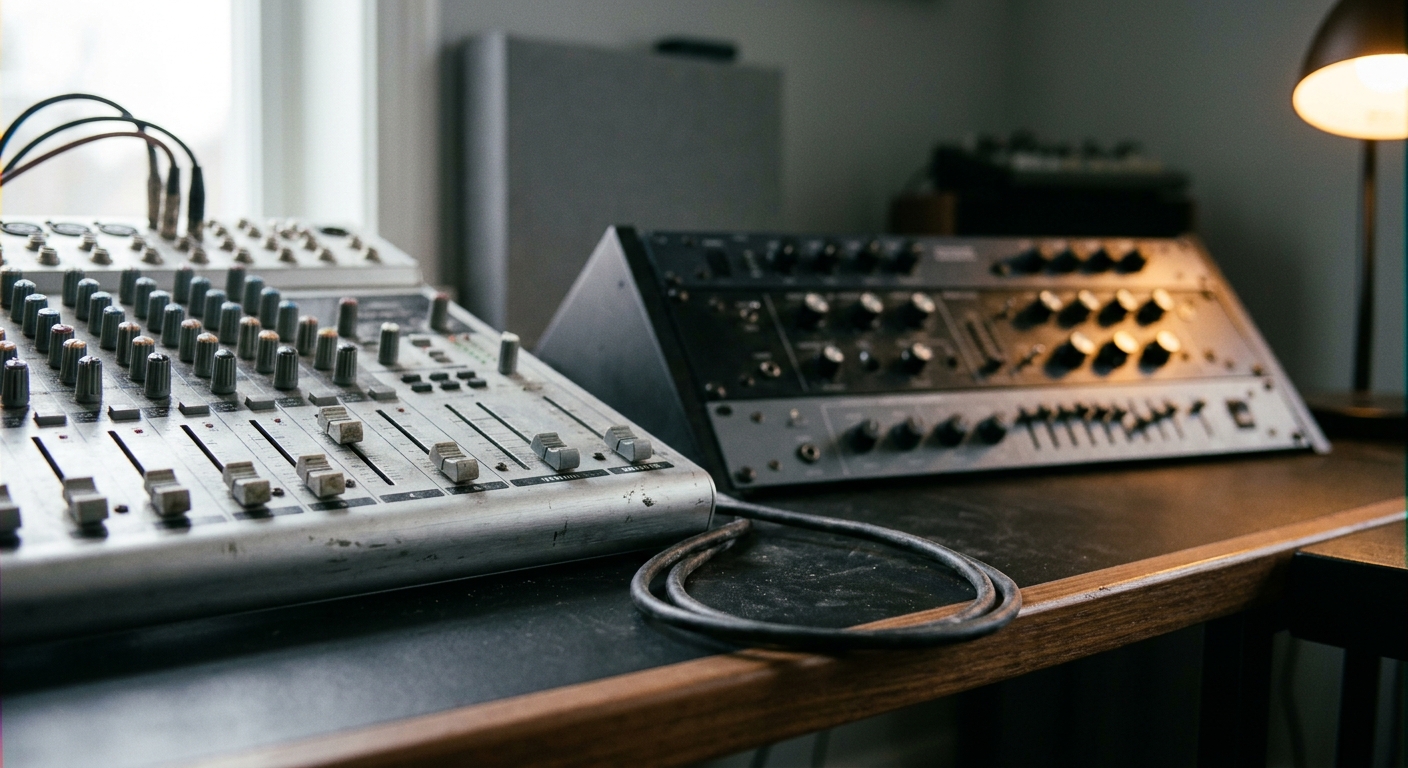
A dub techno delay reverb chain is a send setup. A short, filtered chord stab feeds two echo units. Chorus and reverb follow, and you filter the returns so the low end stays mono when a club PA sums everything together. The tutorials cited here use Ableton’s Echo and Sampler, so the settings follow them. The order and the filtering work in any DAW.
Set Up the Sequence and Source Chord
Set the tempo, then build a dry, short chord stab before any effect goes near it. A four-ingredient dub techno loop can run at 120 BPM with a 909 kick and only 5 channels. That leaves the delays plenty of room to fill.
The “4 ingredients” name comes from the kick and bass sharing one sample, processed two ways. Tune that kick to the key. A1 (55 Hz) suits Am, and C2 (65 Hz) suits Cm, according to Trackscore’s techno mixing guide. You’ll get fewer collisions later. A self-built stab is a better start than dub techno presets with reverb already printed into them, because you can’t shape a space you can’t remove.
What are dub chords?
Think of short minor stabs, filtered hard, with an envelope tight enough that the chord pokes through for a moment before the echoes take over. In the Studio Brootle effects chain the filter envelope Amount sits at 72, so the filter fully engages on every hit.
Velocity then randomises cutoff and envelope time, with Vel at 79% and Time<Vel at -43%. Each stab opens a little differently. So the repeats never sound like copies.
How many BPM is dub techno?
The Studio Brootle loop sits at 120 BPM, and that tempo shapes the delay math. At 120 BPM, a 2/16 delay lands at twice the length of a sixteenth note and a 3/16 delay at three times that length.
Pick the tempo before the delay times, never after.
Build Your Dub Techno Delay Reverb Chain
Send the chord into two stacked echoes, then finish with a high-passed reverb. Transmission Samples’ dub chord guide recommends 300 to 500 ms delay times and high-passed reverb sends as starting points.
Put the delay before the reverb. If the reverb comes first, every repeat carries a full wash and the echoes blur into one pad. With the delay first, you can still count the repeats, and they bloom into space as they fade. For an automated feedback build, the techniques in this guide to techno transition plugins drop straight onto the return.
Which order works for a dub techno delay?
Run two Echo units in series and give them different timing. In the Studio Brootle dub techno effects chain, the first Echo runs 2/16ths in Ping Pong mode. Small left and right error percentages add width. Its Modulation tab adds 11% delay error to imitate tape and space-echo drift.
Set the second Echo to 3/16th, give it different errors, and use less reverb. Two unrelated delay times stop the stab from locking into a single, predictable bounce.
How do I add chorus, saturation, and reverb?
Put chorus after the echoes so it widens the repeats and leaves the dry stab centred. Saturation comes next. It thickens the tails and rounds off their peaks before they reach the reverb, which is why it belongs before the reverb.
Reverb goes last on the chain, with a high-pass on its input, as Transmission Samples advises, though a flanger can share that slot if you want more motion. If you need tools for those steps, these raw techno texture plugins cover saturation and reverb. Keep the effect chain short. Every stage you add stacks more low-mid energy onto the tails. Restraint pays off.
Keep Space Club-Safe on Big Systems
Collapse everything below roughly 150 Hz to mono, and high-pass anything that isn’t kick or bass at 30 Hz or higher. Check the low end in mono, because a mono-summed club PA cancels stereo low end and its sub amplifies rumble you never heard.
Club subwoofers are mono, and Trackscore treats sub-150 Hz mono as mandatory. You should also avoid stacking two sources on the same 60 Hz fundamental, as Track Sensei warns. On a big system, that stack turns boomy and falls apart. A dub chord has no business down there.
How do I EQ delay and reverb returns?
Put the EQ on each return channel and leave the dry stab alone, so the chord keeps its body while the echoes lose theirs. Ping Pong repeats are stereo by design. The 150 Hz mono rule applies to them too. A return high-pass at or above that point is the simplest way to keep them out of the mono zone. Keep it simple.
Apply the same treatment to any flanger and reverb return. Wet signal below 150 Hz is pure risk on a club rig, and it adds nothing you’d miss.
Is my delay reverb chain mono-safe?
Sum the master to mono with a utility plugin, or use a mid-side EQ, and loop the chord section. Listen for repeats that suddenly drop in level or a chorus that turns hollow. Those are phase cancellations.
The stereo delay and chorus stages cause most of the trouble. Different left and right error amounts on Echo make the two sides drift apart, and chorus pushes them further. Trim the chorus first. If the mono sum thins out, reduce the chorus depth before you touch the delays. Width you lose in mono was never reaching the club anyway.
Troubleshooting: Muddy, Washed-Out Dub Chords
Dub chords go muddy when low-end and low-mid content piles up across returns and channels. They wash out when reverb buries the stab’s attack. Trackscore puts healthy techno low-mid energy at 10 to 13% of total spectral energy, and the 250 to 500 Hz band is where boxy mixes start.
No dub delay VST fixes this on its own. High feedback into an unfiltered reverb will swamp the chord in any plugin, so check the filtering and the gain staging of the whole effect chain first.
Why is my dub techno delay muddy?
Sign: the chords sound thick and unclear, and the kick loses punch whenever the echoes build. Cause: Trackscore points to invisible low-end content collecting across 20+ channels, and delay feedback multiplies it with every repeat.
Fix: high-pass everything except kick and sub-bass. Then cut the 250 to 500 Hz band on any dub delay return that doesn’t need it, which in techno is most of them. Save the cut, and lower the feedback only if the mud stays.
Why does my reverb vanish on club systems?
Sign: tails that sound deep on headphones disappear on the PA, and the chord turns dry. Cause: wide stereo reverb and chorus cancel when the system sums to mono, and any low content left in them gets masked by the sub.
Fix: run the mono check, narrow the reverb return, and keep its high-pass above 150 Hz. Swapping plugins won’t save a return that cancels in mono, whichever dub VST you choose. Check mono first. If the tails survive the Utility mono switch, they’ll survive the PA.
FAQs
1. What is dub techno music?
Dub techno blends the steady pulse of techno with dub’s echo, reverb, and spacious mixing. Basic Channel helped shape the style, and echoing chord stabs define its sound.